Case study · Indosat · Circle Kalisumapa · 2026
PROTRACK: proof the promoter was really there.
Promoters sell IM3 and 3 SIM cards at phone shops and are paid per card. PROTRACK is the app they work in: check in at the outlet, record each card sold, see whether it activated. Every step checks where they are and which phone they use, because money depends on it.
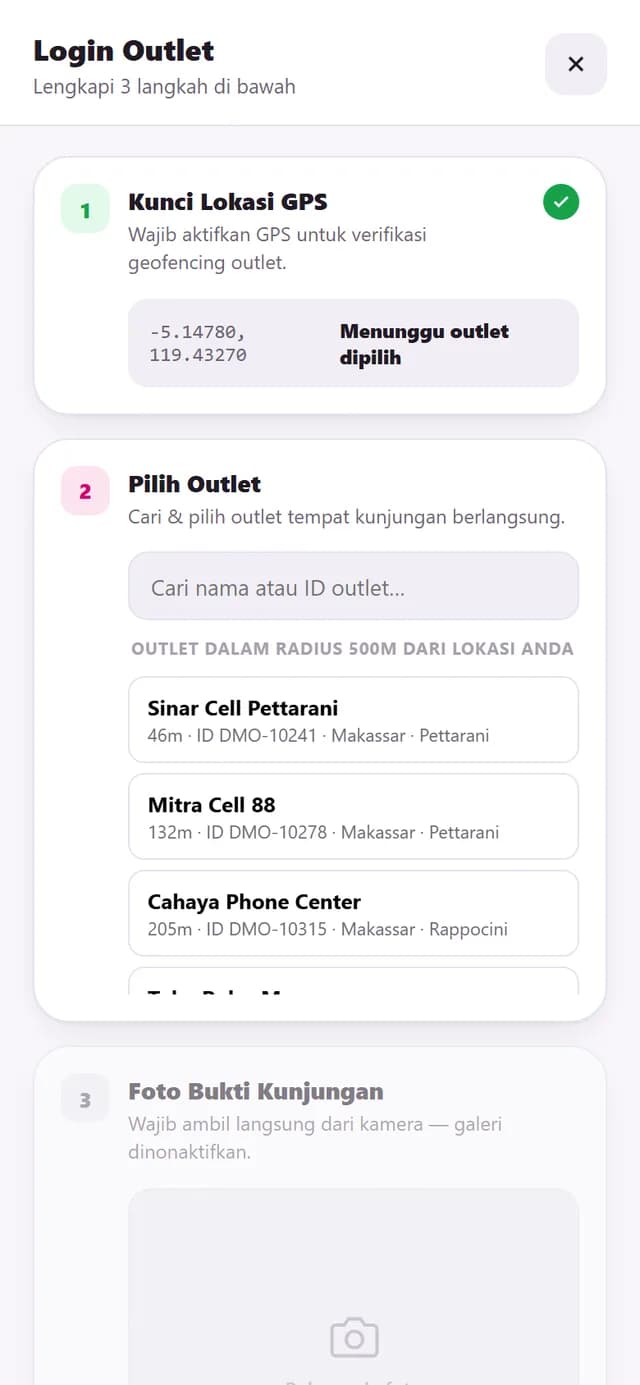
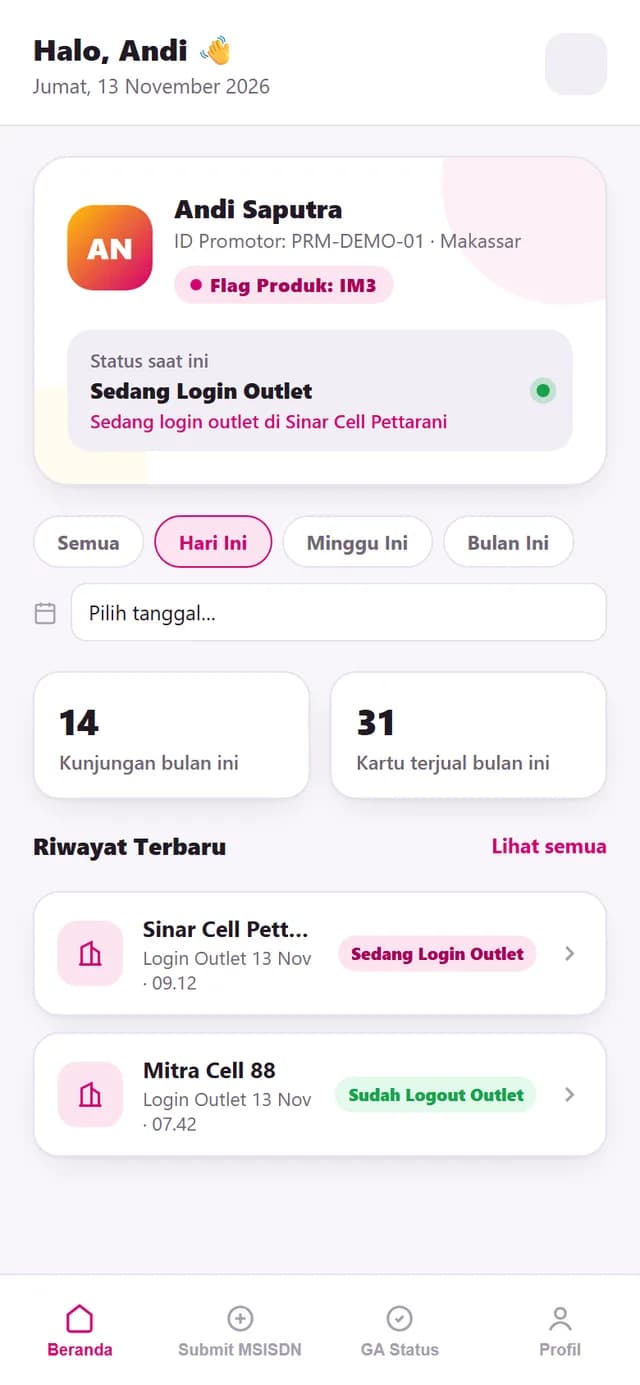
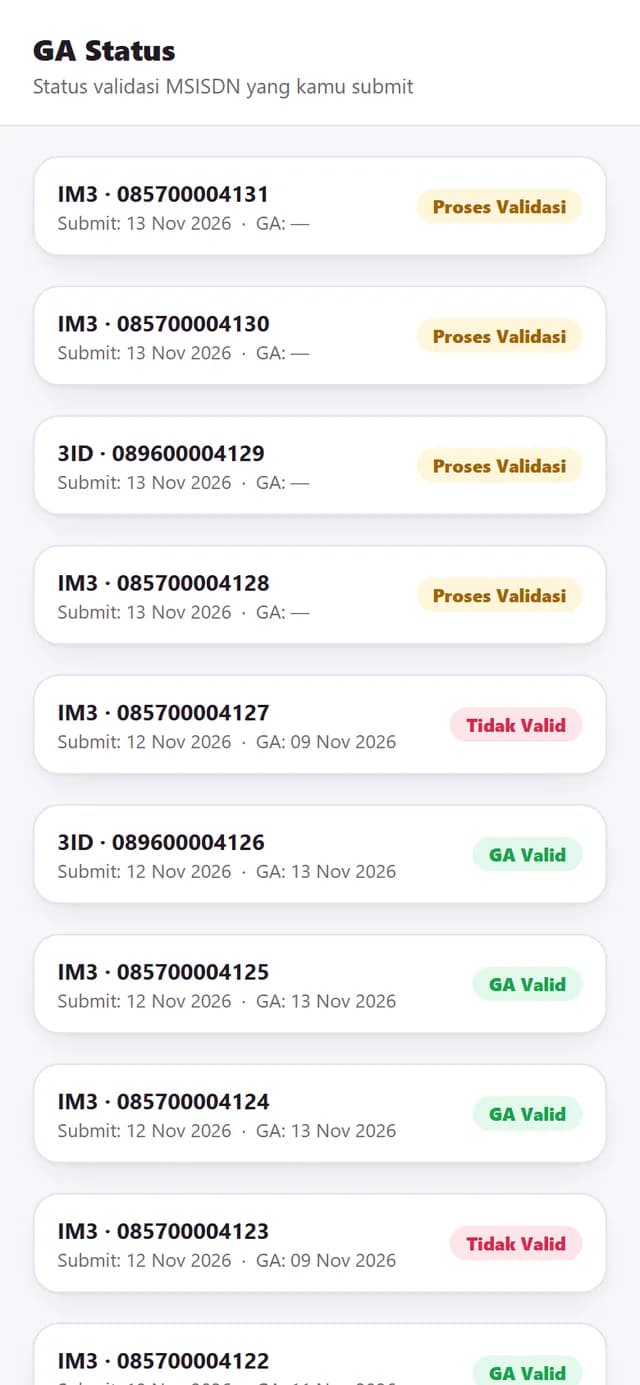
Screens: the real app running on demo data. No real promoters, outlets or phone numbers.
01 · A visit
Three steps, each one checked.
A promoter can't move to the next step before the last is done, and nothing can be sent from outside the outlet.
Lock GPS
The server measures the distance to every outlet in the master list in one vectorised pass and returns those within 500 m, nearest first.
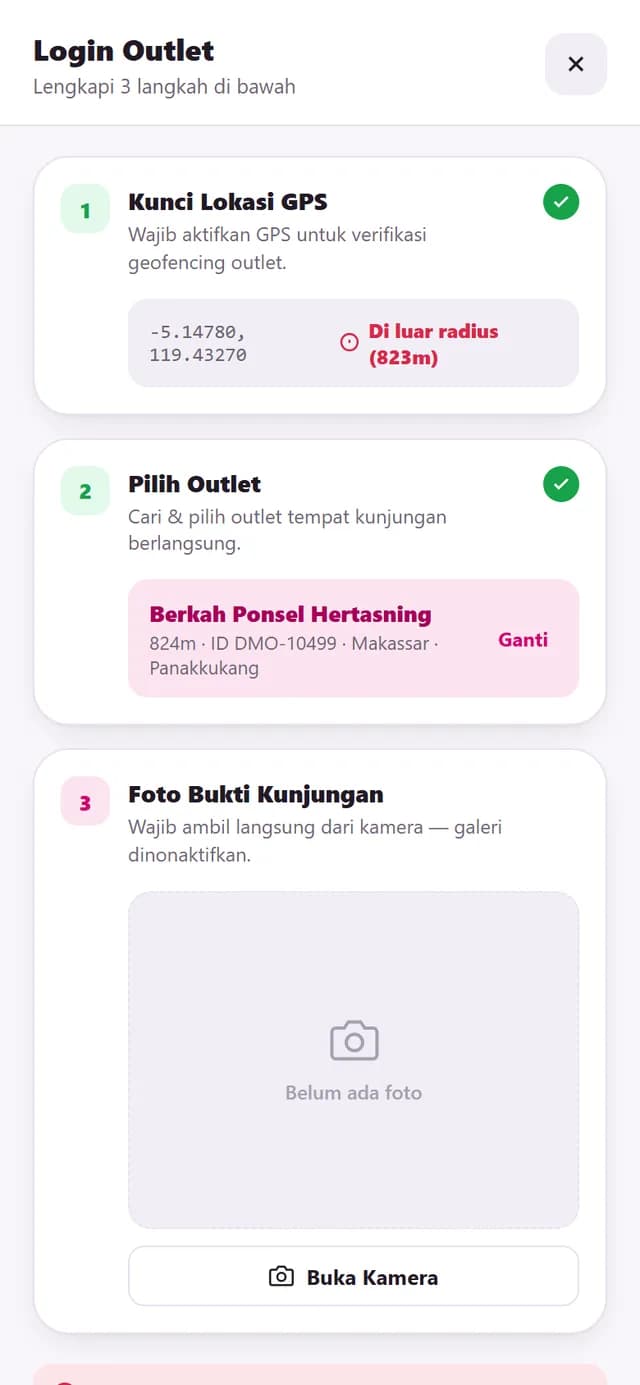
Pick the outlet
The distance is checked as soon as an outlet is picked. Too far, and the check-in can't be sent. The server checks again anyway.
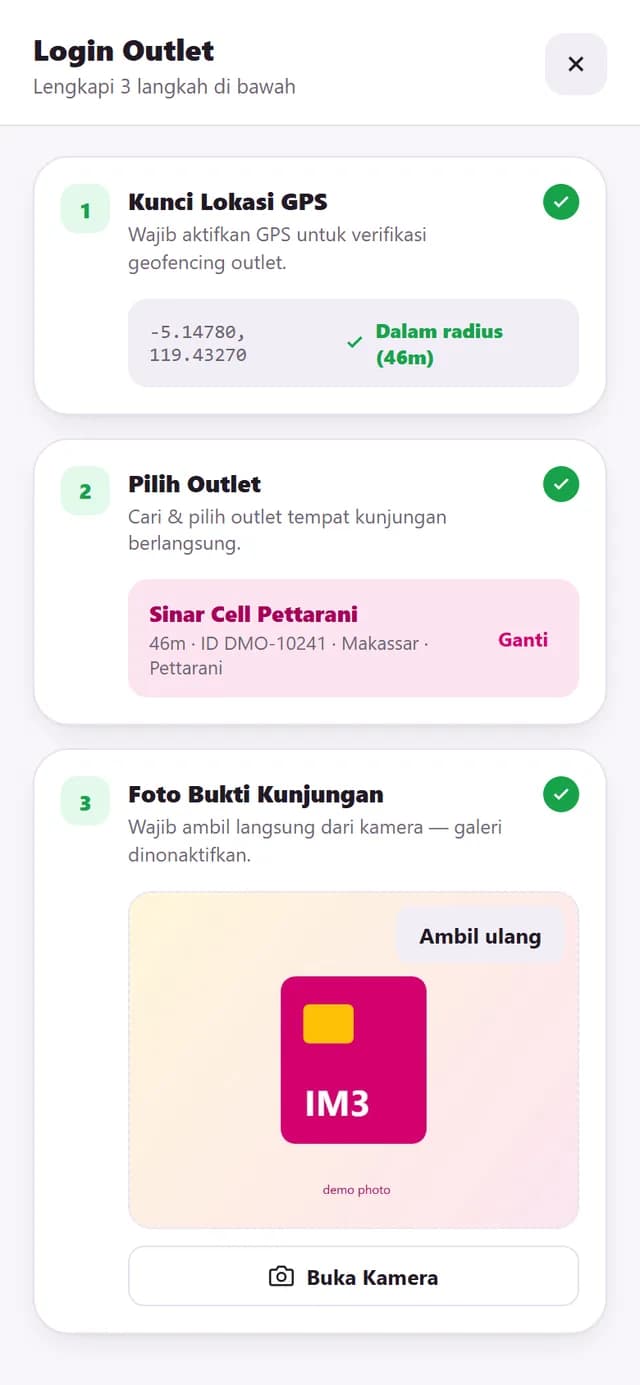
Photo from the camera
The photo button opens the camera, not the gallery, so an old photo can't be reused. Then the button turns on.
02 · Try to cheat
Seven checks before a check-in is saved.
Sales fees depend on check-ins, so people will try. Pick your tricks and send: the server runs its checks in this order, and the first one that notices stops the request with the app's real message.
Pick your tricks
1 trick on. The first check that notices one stops the request.
Server · POST /checkin
- 1
Signed by a registered phone
a key in Android Keystore signs a one-time nonce and timestamp
- 2
It's a photo
jpeg, png or webp, taken with the camera
- 3
GPS isn't faked
Android's own mock-location flag
- 4
The trip is possible
distance and time since the last check-in
- 5
No other visit open
one outlet at a time
- 6
The outlet exists
looked up in the outlet master list
- 7
Within 500 m of the outlet
great-circle distance to the outlet's coordinates
03 · Why an Android app
A web app in a native shell, for what browsers can't do.
The screens are one web app, so updates ship without a new APK. The Android shell adds three bridges the browser doesn't have.
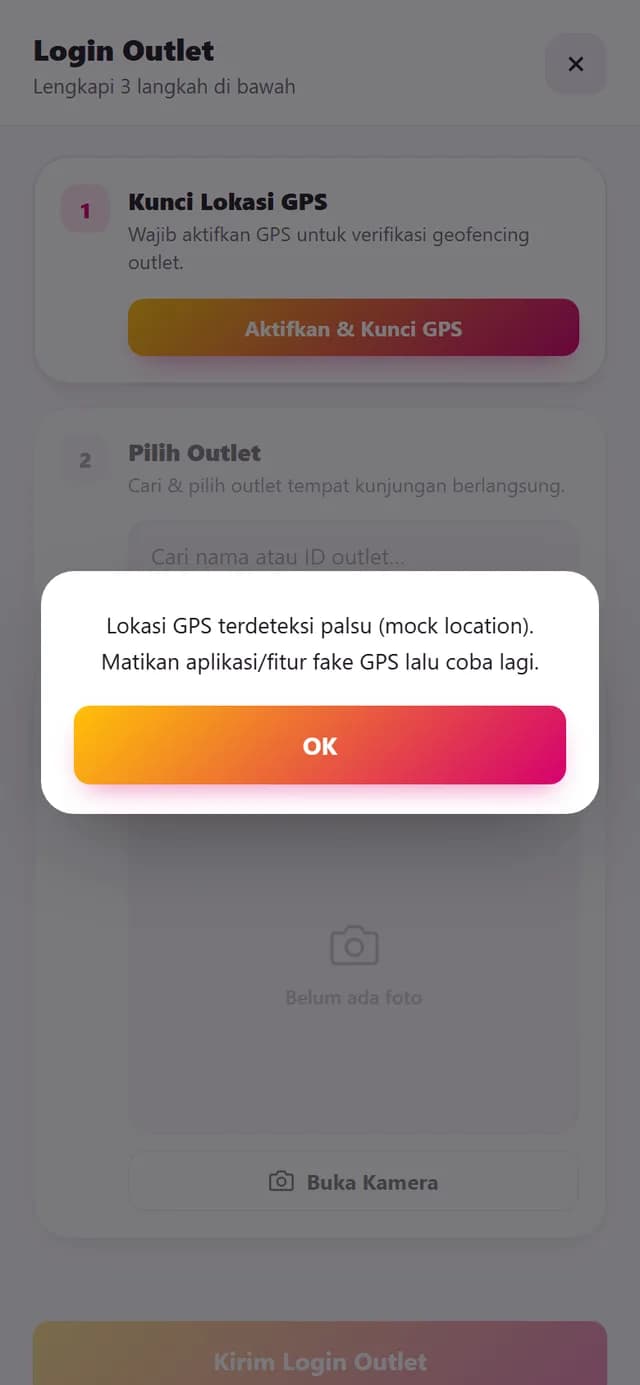
Location bridge
Reads Android's own mock-location flag (Location.isMock), which no browser can see. A fake-GPS app is caught on the phone, and the server refuses the request too.
Device key
On first use the phone makes a key pair inside Android Keystore. The private key never leaves the phone; the server keeps only the public key. Every check-in is signed over a one-time nonce and a timestamp, so a request copied off the phone can't be replayed, and a decompiled APK holds no secret.
Camera
Photo fields open the camera directly, so evidence is taken there and then.
how a check-in is signed
Phone
nonce = random UUID
ts = now
sig = sign(nonce:ts) in Keystore
Server
ts recent? else refuse
nonce used before? refuse
verify sig with stored public key
04 · Every SIM once
Scan it, and it can only count once.
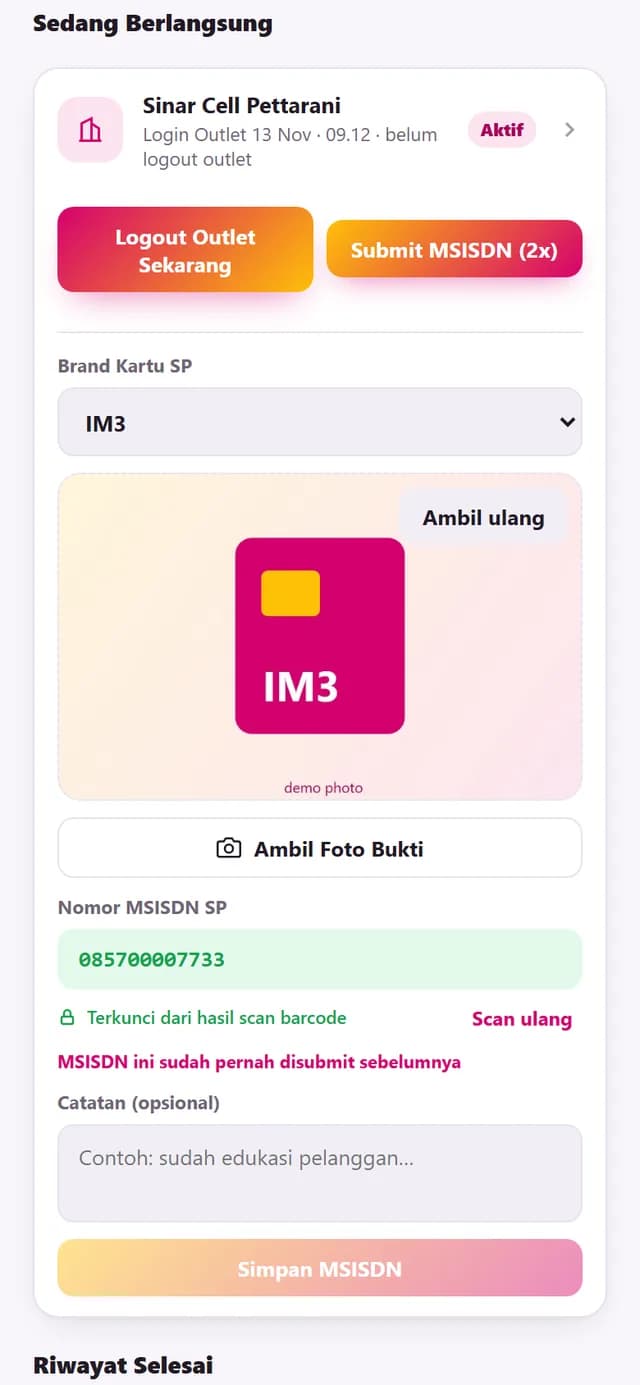
Each SIM card sold is a fee, so the same number must never be claimed twice, by the same promoter or anyone else.
Scan, then locked
Scanning the barcode on the SIM pack fills the number and locks the field; changing it means scanning again. Each record notes whether it was scanned or typed.
Warned while typing
A live check says if the number was ever submitted, by anyone. Only the latest response counts, so a slow reply can't show a stale warning.
One claim, guaranteed
On save the server claims the number in a transaction, one document per number, so two taps at the same moment can't both win. If the photo upload fails after that, the claim is released.
Still at the outlet
Submitting checks the 500 m radius again, so a forgotten logout can't be used to submit from somewhere else.
05 · Did it activate?
Every card checked against the activation data.
A sale only counts if the card was activated. The monthly activation (GA) files are read straight from the same Cloud Storage bucket the admin portal uses: no copies to drift apart.
The server builds a lookup of each number's first activation date across all months (cached for half an hour), then compares it with the day the promoter submitted it.
06 · The small stuff
What keeps it honest on a busy day.
Location only while working
During an open visit the app sends its position every minute, appended to the visit's route for the live map in the admin portal. Logging out of the outlet stops it.
One visit at a time
A quick check rejects a second check-in early; a Firestore transaction guarantees it when two requests race.
Only real promoters sign up
The ID must be on the official SalesHub roster. ID, email and phone number are each unique, phone numbers normalised to 62…
Rate limits that hold
Login and sign-up attempts are counted in Firestore, not in memory, so the limit is shared by every server instance.
Sessions and passwords
A 12-hour JWT in an httpOnly, secure cookie; passwords hashed with bcrypt; security headers and a strict content policy.
Messy outlet data
About 0.4% of outlets have missing or impossible coordinates. They're marked “location not validated” instead of wrongly rejecting the promoter.
Light photos
Every photo is compressed on the server before it goes to Cloud Storage.
Old app versions
The web app detects an outdated Android shell and tells the promoter where to get the new one.
07 · How it fits together
One backend, one bucket, two front doors.
Promoter's phone
PROTRACK app
Kotlin WebView shell: fused location, Keystore signing, camera. Web app inside: vanilla JS, ZXing barcode scanner.
Google Cloud Run
FastAPI backend
Auth, outlet search, check-in, checkout, live tracking, SIM tagging, GA status. Pandas for the outlet master and GA files.
Firestore
promoters, check-ins, SIM claims, device keys, nonces, rate limits
Cloud Storage
photos, outlet master, GA files, activity log
Office
Admin portal
Live tracking map, access management, GA validation for fee claims, on the same data.