Case study · Internal tool · 2026
Embed Hub: every team's Excel dashboards, one sidebar.
Teams publish their dashboards as Excel for the web, and the links used to live in chats and bookmarks. Embed Hub gives them one home: the admin makes the menus, data owners paste the embed code once, and viewers open it without hunting. Who can see the sheet itself is still decided by Microsoft 365.
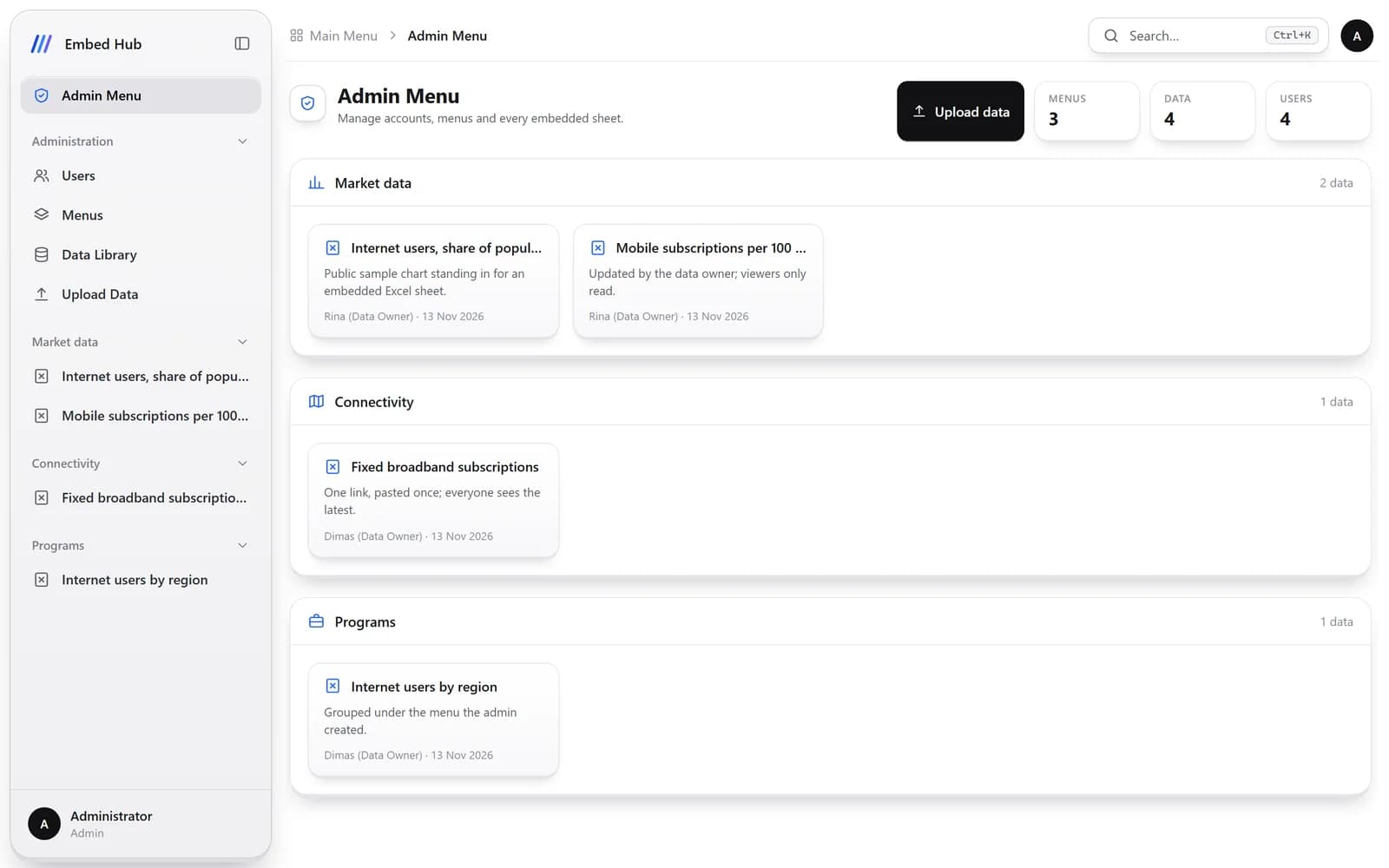
Screens: the real app running on demo content. Charts are public sample charts standing in for Excel sheets.
01 · How it's used
Menus, then embeds, then reading.
- 1
Admin builds the structure
Creates accounts and sidebar menus (a name and an icon), and puts them in order.
- 2
Owner pastes an embed
The iframe code or just the link. The form shows the detected host straight away and offers a sandboxed preview.
- 3
Server keeps only a clean link
It pulls out the URL, checks it hard and saves that, never the pasted HTML.
- 4
Viewer opens it
Menus with items appear in the sidebar; the sheet opens in a sandboxed frame with reload, full screen and open-in-new-tab.
02 · Try to paste something
What the server accepts, and why.
This is the server's own check, run in your browser. Paste an iframe, a link, or something that shouldn't be there.
Paste the embed code or link
Accepted · saved as
Link detected: contoso-my.sharepoint.com
https://contoso-my.sharepoint.com/personal/demo/_layouts/15/Doc.aspx?sourcedoc={0000}&action=embedview&wdAllowInteractivity=False
Viewers get it in a sandboxed iframe; the pasted HTML itself is thrown away.
03 · Under the hood
Small, strict, and dependency-free.
Only the link survives
The src is pulled out of the iframe; anything else with a < is refused; spaces are refused; it must parse as a URL and start with https://. An optional allow-list limits the hosts.
A JSON store that can't half-write
Users, menus, items and sessions live in memory and are saved by writing a temp file and renaming it over the old one.
A header against forged requests
Every write must carry a custom header, checked before login is even looked at; together with strict cookies, other sites can't post on your behalf.
Passwords with scrypt
16-byte salt, 64-byte key, compared in constant time; unknown usernames still run a dummy hash.
Brute force capped
Ten failures in 15 minutes from one address get a 429; a successful login clears the count.
Owners own their items
An owner edits and deletes only their own; deleting a user hands their items to the admin. The last admin can't be removed.
04 · Who sees what
Three roles.
Admin
Accounts, menus and every item.
Data owner
Adds items under any menu and edits or deletes only their own.
Viewer
Reads. Menus without items are hidden from them.
05 · The small stuff
Hardening for a one-file server.
Content policy
Scripts only from itself, frames only over https, and the hub itself can't be framed.
Sandboxed frames
Embeds run with only the permissions a spreadsheet needs: scripts, forms, popups, downloads, full screen.
Size limits
Request bodies over 100 KB are refused; bad JSON gets a clear 400.
No path tricks
Static files are served only from the public folder, with traversal blocked.
No HTML from users
Every user string is rendered as text, never as HTML.
Sessions
A random token in a strict, httpOnly cookie; only its hash is stored. A password reset ends that user's sessions.
Keyboard first
Ctrl+K searches every page and item.
One instance on purpose
Deployed with a single instance and a mounted bucket, because the store and rate limit live in memory.
06 · How it fits together
A browser, one Node file and a JSON file.
Browser
Single-page app
Vanilla JS with a hash router and a command palette; embeds load straight from Microsoft into a sandbox.
Cloud Run
node:http server
Route table, sessions, role checks, validation; no framework, no npm packages.
JSON store
users, menus, items, sessions
Bucket volume
keeps the store across restarts
Microsoft 365
The sheets
Excel for the web serves the actual dashboards and decides who may see them.
07 · Tech stack
What each piece does.
Node.js 18 standard library
HTTP server, crypto (scrypt), files. Zero dependencies.
Vanilla JS + CSS
The whole front end.
JSON file store
All data, written atomically.
Cloud Run + Cloud Storage
Hosting, with the store on a mounted bucket.
Excel for the web
The embedded dashboards.